 Oncosphere
Approvals · for clinicians and patients
Dostarlimab gets FDA accelerated approval for MSI-H/dMMR locally advanced rectal cancer
On 19 October 2026, the US FDA granted accelerated approval to dostarlimab (Jemperli, GSK) for adults with Stage II/III locally advanced rectal cancer that is MSI-H or dMMR, as determined by an FDA-authorised test.
Background
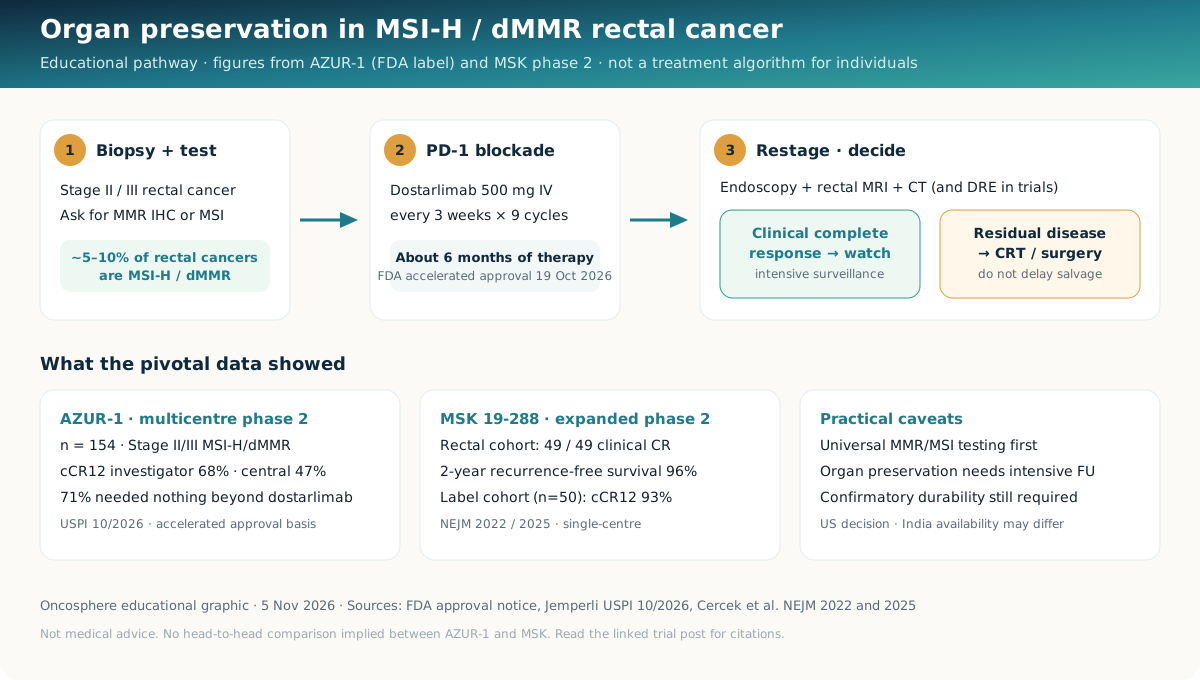
About 5–10% of rectal cancers are mismatch-repair deficient. The landmark single-centre study from Memorial Sloan Kettering (Cercek et al., NEJM 2022) reported that the first 12 patients treated with dostarlimab alone had a clinical complete response, avoiding chemoradiation and surgery at the time of reporting.
Updated evidence: the expanded MSK study (NEJM 2025)
The same phase 2 study was expanded to 117 patients with Stage I–III dMMR tumours, given 6 months of dostarlimab. [NEJM 2025] [PMC full text]
- Rectal cohort: all 49 of 49 patients who completed treatment had a clinical complete response, and none needed surgery on the primary tumour. 37 had a sustained complete response at 12 months, meeting the primary endpoint.
- Rectal cohort durability: 2-year recurrence-free survival 96% (95% CI 90–100), median follow-up for recurrence 30.2 months.
- Other dMMR tumours (colon, gastric, urothelial and others): 35 of 54 (65%) had a clinical complete response; 2-year recurrence-free survival 85%.
- Safety: 95% of patients had either no adverse events (35%) or reversible grade 1–2 events (60%). No patient lost the chance of curative surgery.
Cercek et al., N Engl J Med 2025;392:2297. Single-centre, single-arm study.
The pivotal trial behind the approval: AZUR-1
The approval rests mainly on AZUR-1 (NCT05723562), a multicentre, single-arm phase 2 trial of dostarlimab alone in 154 previously untreated MSI-H/dMMR Stage II/III rectal cancers (86% Stage III; 26% T4). Dostarlimab 500 mg IV every 3 weeks for 9 cycles; response checked by endoscopy, rectal MRI and CT at week 6, week 12 and about 3 weeks after the last dose. Interim cut-off 20 Apr 2026, median follow-up 26 months. [FDA] [USPI 10/2026]
| Endpoint (AZUR-1) | Investigator | Independent central review |
|---|---|---|
| Evaluable for 12-month sustained cCR (cCR12) | 144 | 116 |
| cCR12 (primary endpoint is per central review) | 68% (95% CI 60–76) | 47% (95% CI 37–56) |
| Objective response | 82% (75–88) | 79% (71–85) |
| Clinical complete response | 66% | 28% |
| Near-complete response | 6% | 29% |
- The gap between investigator and central-review cCR12 is largely immature follow-up: 38 patients in cCR by central review had less than 12 months of follow-up at cut-off, and 44 more were near-complete responders.
- What happened to the 154: 110 (71%) needed nothing beyond dostarlimab and had not progressed; 26 (17%) had surgery; 13 (8%) had extra systemic therapy or radiation; 1 progressed without further treatment; 4 withdrew.
- Of 15 who went to surgery after dostarlimab alone because imaging suggested residual tumour, 12 had a pathological complete response.
- No progression among patients with cCR12, cCR or near-cCR at median follow-up of 26.3 months.
- Safety (n=154): serious adverse reactions 20%; discontinuation for toxicity 3%; immune-mediated reactions 23%. Commonest: fatigue 32%, rash 22%, diarrhoea/colitis 18%, pruritus 17%, hypothyroidism 13%. Rectal stenosis 3.9%; one death from sepsis linked to intestinal obstruction and post-surgical complications.
Jemperli USPI 10/2026, section 14.2. Single-arm studies; central-review figure is immature.
The FDA also reviewed the MSK study (19-288, n=50 in the label): cCR12 93% (95% CI 82–99), objective response 100%, no chemoradiation or surgery needed; among 27 patients followed at least 3 years, 1 local recurrence (treated with lymphadenectomy). [USPI 10/2026]
Confirmation required: AZUR-1 must report cCR24 and cCR36, 3-year organ-preservation and relapse rates, and 5-year survival (trial completion 10/2029, final report 07/2030). [FDA letter] GSK says a combined complete-response rate of 76% (110/144, counting pCR at surgery) will be presented as an ESMO 2026 late-breaker. [GSK]
For patients
If you have rectal cancer, ask whether your biopsy has been tested for MMR (mismatch repair) or MSI. The result can change which treatment is best.
Accelerated approval means continued approval may depend on confirmatory trials. This is a US decision.
How the treatment is given
In the Memorial Sloan Kettering study, dostarlimab 500 mg was given intravenously every 3 weeks for 6 months. Patients with a clinical complete response (by endoscopy, MRI and digital rectal examination) entered watch-and-wait follow-up instead of chemoradiation and surgery. [NEJM 2022] The approved label dose is the same: 500 mg IV every 3 weeks for 9 cycles (about 6 months). [USPI 10/2026] Non-operative surveillance in AZUR-1 was every 4 months for 2 years, then every 6 months.
Why dMMR tumours respond
Mismatch-repair–deficient tumours accumulate thousands of mutations, producing neoantigens that the immune system can recognise once the PD-1 “brake” is released. The same biology underlies immunotherapy benefit in dMMR metastatic colorectal cancer (KEYNOTE-177). [NEJM 2020] dMMR rectal tumours, in contrast, respond relatively poorly to standard chemotherapy.
What accelerated approval does and does not mean
- It is based on a surrogate endpoint (here, clinical complete response) that is “reasonably likely” to predict clinical benefit.
- Durability beyond a few years, and the best surveillance schedule, are still being studied.
- Organ preservation requires intensive follow-up: regular MRI, endoscopy and CEA. Missing follow-up visits is risky.
Questions to ask your doctor
- Has my tumour been tested for MMR proteins (MLH1, MSH2, MSH6, PMS2) or MSI?
- If dMMR, could I have Lynch syndrome, and should my family be tested?
- Is immunotherapy available to me, and what follow-up would organ preservation need?
Sources
- FDA — FDA grants accelerated approval to dostarlimab for locally advanced rectal cancer (19 Oct 2026)
- Jemperli (dostarlimab-gxly) US Prescribing Information, revised 10/2026 (sections 1.2, 2, 6.1, 14.2)
- FDA approval letter BLA 761174/S-015 (postmarketing requirement 5084-1)
- GSK press release, 24 Oct 2026 — AZUR-1 interim results (ESMO 2026 late-breaker)
- FDA — Oncology/Hematologic Malignancies Approval Notifications (entry dated 19 Oct 2026)
- Cercek A, et al. PD-1 Blockade in Mismatch Repair–Deficient, Locally Advanced Rectal Cancer. N Engl J Med 2022
- Cercek A, et al. Nonoperative Management of Mismatch Repair–Deficient Tumors. N Engl J Med 2025;392:2297–2308
- André T, et al. KEYNOTE-177. N Engl J Med 2020
Educational summary, not medical advice. Opinions are labelled as such and are the author's own. Approvals and availability in India (CDSCO) may differ from the US/EU.