 Oncosphere
Approvals · for clinicians
Rybrevant Faspro for pretreated head and neck cancer: FDA accelerated approval, 5 November 2026

US accelerated approval on 5 November 2026 for subcutaneous amivantamab plus hyaluronidase in adults with recurrent or metastatic HNSCC after platinum chemotherapy and a PD-(L)1 antibody. OrigAMI-4 (n=102) showed an ORR of 42% (95% CI 32–52%); 56% of responders had a duration of response of at least 6 months. It is not indicated for HPV-associated oropharyngeal cancer. Continued approval depends on confirmatory OrigAMI-5. This is not a CDSCO approval.
On 5 November 2026 the US Food and Drug Administration granted accelerated approval to amivantamab and hyaluronidase-lpuj (Rybrevant Faspro, Janssen Biotech) as a single agent for adults with recurrent or metastatic head and neck squamous cell carcinoma (HNSCC) whose disease has progressed on or after platinum-based chemotherapy and an anti-PD-(L)1 antibody. The indication does not include oropharyngeal squamous cell carcinoma that is HPV-associated, assessed by p16 immunohistochemistry.
Approval rests on overall response rate and duration of response. Whether those surrogates will translate into a long-term clinical benefit is not yet confirmed; continued approval may depend on the confirmatory phase 3 trial, OrigAMI-5.
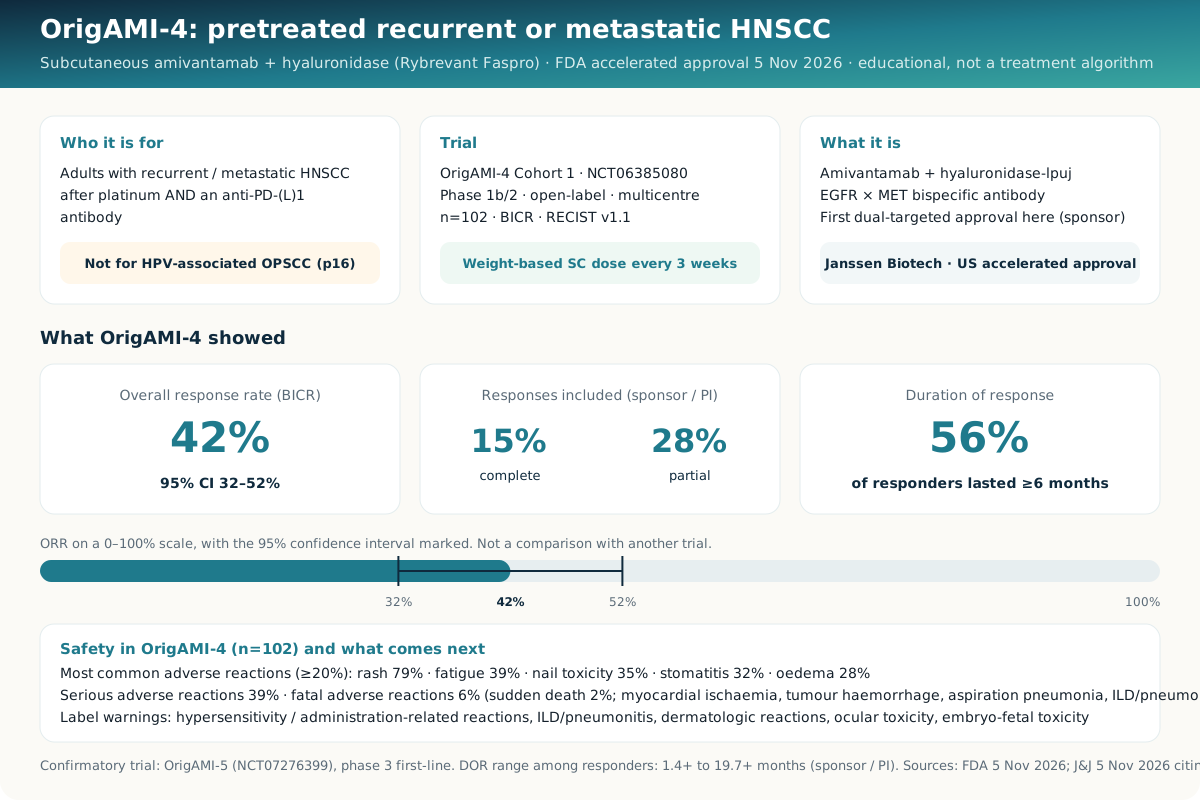
How to read the figure
The three headline numbers are from the same 102-patient efficacy population in OrigAMI-4 Cohort 1. The 42% overall response rate (95% CI 32–52%) is in both the FDA approval notice and the sponsor release. Complete responses (15%) and partial responses (28%) come from the sponsor release, which cites the US prescribing information; they are components of that ORR, not a second trial. Duration of response — 56% of responders with DOR of at least 6 months, per the FDA; the sponsor release citing the label also gives an observed range of 1.4+ to 19.7+ months. The bar is that ORR on a 0–100% scale with the confidence interval marked; it is not a comparison with another study.
OrigAMI-4 in brief
Efficacy was evaluated in OrigAMI-4 (NCT06385080), a multicentre, open-label, multi-cohort phase 1b/2 trial. The primary efficacy population included 102 patients with recurrent or metastatic HNSCC and excluded patients with HPV-associated oropharyngeal cancer based on p16 testing. Eligible patients had to have received previous platinum-based chemotherapy and an anti-PD-(L)1 antibody. They received single-agent, weight-based amivantamab plus hyaluronidase subcutaneously every 3 weeks at the recommended dose until disease progression or unacceptable toxicity.
The major efficacy outcomes were overall response rate and duration of response, determined by blinded independent central review according to RECIST v1.1:
- ORR 42% (95% CI 32–52%). The sponsor reports this included complete responses in 15% of patients and partial responses in 28%.
- Duration of response: 56% of responders had a DOR of at least 6 months (FDA). The sponsor release, citing the US prescribing information, also reports that 56% maintained a response for more than 6 months (range 1.4+ to 19.7+ months).
The recommended dose is based on body weight; see the prescribing information rather than inferring a milligram dose from this note. The FDA used the Assessment Aid and reviewed the application under Project Orbis with Brazil’s ANVISA, Health Canada, Israel’s Ministry of Health and Singapore’s HSA. Partner reviews may still be underway. The agency granted Breakthrough Therapy designation (February 2026) and Priority Review (July 2026), according to the sponsor.
Amivantamab is a bispecific antibody directed at EGFR and MET. The subcutaneous product is co-formulated with recombinant human hyaluronidase. The sponsor describes this as the first dual-targeted approval in this setting and the first Rybrevant Faspro indication beyond non-small cell lung cancer.
Pivotal results were presented at the 2026 ASCO Annual Meeting and published as Burtness and colleagues in the Journal of Clinical Oncology (2026;44(24):2271–2277).
Safety in OrigAMI-4 (n=102)
According to the sponsor’s 5 November 2026 release, which cites the US prescribing information, the most common adverse reactions (≥20%) were rash (79%), fatigue (39%), nail toxicity (35%), stomatitis (32%) and oedema (28%).
Serious adverse reactions occurred in 39% of patients. Those reported in at least 2% included pneumonia (8%), haemorrhage (4.9%), dysphagia (2.9%), pneumothorax (2.9%), anaemia (2%), dyspnoea (2%), fatigue (2%), hepatic enzyme increased (2%) and ILD/pneumonitis (2%).
Fatal adverse reactions occurred in 6%, including sudden death (2%) and myocardial ischaemia, tumour haemorrhage, aspiration pneumonia and ILD/pneumonitis (1% each, one patient each).
The FDA lists warnings and precautions for hypersensitivity and administration-related reactions, interstitial lung disease (ILD)/pneumonitis, dermatologic adverse reactions, ocular toxicity and embryo-fetal toxicity. The sponsor lists a contraindication in patients with known hypersensitivity to hyaluronidase or any excipient.
What still needs confirming
OrigAMI-5 (NCT07276399) is the ongoing randomised phase 3 confirmatory trial. The sponsor describes it as evaluating subcutaneous amivantamab with carboplatin and pembrolizumab as first-line treatment for recurrent or metastatic head and neck cancer. The FDA’s accelerated-approval table lists completion of OrigAMI-5 as the post-marketing requirement for this indication, with a projected completion date of 31 May 2029.
For readers in India
An FDA accelerated approval does not mean CDSCO approval, hospital availability or reimbursement here. Confirm p16 or HPV status for oropharyngeal primaries — this US indication excludes HPV-associated oropharyngeal squamous cell carcinoma. Later-line options after platinum and immunotherapy remain limited in many Indian centres. If the product becomes available, rash, ILD/pneumonitis and administration-related reactions will need the same attention as on the label. We will update this note if an Indian approval or access route is announced.
Related: FDA oncology approvals, October 2026 · Three oncology FDA decisions still ahead in November 2026 · Infographics gallery.
Sources
- FDA — accelerated approval of amivantamab and hyaluronidase-lpuj for recurrent or metastatic HNSCC (5 Nov 2026)
- FDA — Oncology/Hematologic Malignancies Approval Notifications
- FDA — Ongoing cancer accelerated approvals (OrigAMI-5 post-marketing requirement)
- Johnson & Johnson — FDA approval of RYBREVANT FASPRO in advanced head and neck cancer (5 Nov 2026)
- ClinicalTrials.gov — OrigAMI-4 (NCT06385080)
- ClinicalTrials.gov — OrigAMI-5 (NCT07276399)
- Burtness et al. — OrigAMI-4 pivotal results, Journal of Clinical Oncology 2026;44(24):2271–2277
Educational summary, not medical advice. Opinions are labelled as such and are the author's own. Approvals and availability in India (CDSCO) may differ from the US/EU.